
 Posts
Posts


[You can view the PDF here.]
One should always be weary when educators go on to praise management experts – after all, the practice, if taken too far, is only one fell swoop away from mass commoditization of learning. Indeed, that some classes have become scripted – teaching “from the book,” never mind “to the test” – with detailed prompt book and handheld timer is a discouraging sign.
There is the occasional idea that does not support the idea of teachers as “managers,” like the support for block scheduling. Deming is right, Robert Lynn Canady says in his Power of Innovative Scheduling: “it is more often the structure of an organization than the inadequacies of the people who work within it that causes problems.” Schools, he writes, confront the issue of providing quality time, creating a school climate, and providing varying learning time; they are handicapped by “fragmented instructional time … an issue at all levels of schooling.”[1]
Block scheduling seeks to benefit students by reigning in their focus from some seven classes per day, all the while reducing their stresses, maximizing the opportunities to flatten out material; teachers by allowing them to prepare for fewer courses and students and reducing the amount of grades and records to maintain. It does so by cutting a student’s classes per day down to four, at lengths ranging from one to two hours, and rotating the classes on a class today, different set of classes the next schedule.
The trend’s popularity has now begun to supplant the mania for lower class sizes. Each, it should be pointed out, are focused on providing ‘quality time’ to each student. Similarly, an emphasis on greater time for studies is a central factor in America’s popular KIPP hybrid schools: as one of its five pillars, the program’s site marks its understanding that there are “no short cuts” to learning. Longer school days, weeks, and years, the program says, is the proper way to go about it.[2] An analysis is due:
In the simplest of scenarios (the simpler, the better), little more time is needed for students to master their material. To venture into a math class, time is chopped up between a warm-up exercise, a review of the previous night’s homework, and the day’s lesson. Unfortunately, math is a difficult subject.
The warm-up, typically a review of a subject “learned” some time ago, all too often grows from a five-minute exercise to a fifteen-minute review – one third of a forty five minute class. The homework review – intended to be a reading of the answers – turns into a review of the previous day’s lesson as well. At best, ten minutes remains to teach a lesson that requires some fifteen minutes more. Without it, a vicious cycle of misunderstanding takes place, only further clamping down the time available for the new lesson.
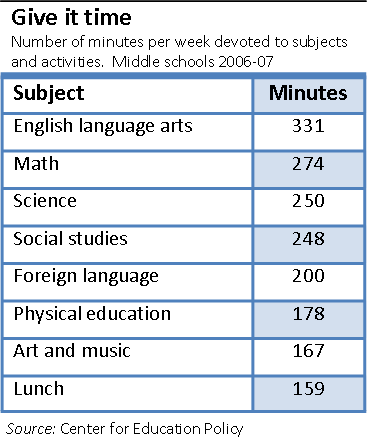 Where block-scheduling advocates move for ninety-minute sessions, Kansas advocates and extension of a mere fifteen minutes. The logic of block scheduling, Kansas argues, is based around lingering confusion; yet if the lesson were taught effectively the first time, the energy spent on the warm-up and review is reduced to accommodate time for a full lesson.
More specifically, measurable benefit from reduced class sizes was found in classes with less than eighteen students.[3],[i] This paper argues that one should look beyond class size, to take a look at the amount of time afforded to each child.
Indeed, the classroom’s chaos theory would have it that each increase in student causes more distraction and question, in turn necessitating more time to effectively teach each student. In a forty-five minute class with eighteen students, the average time allocated per pupil is 2.5 minutes. Under such a scenario, a class of 24 would require 60 minutes of class time.
One should – if taking into account the tendency of classroom chaos – analyze a progressive allocation. With eighteen students at 2.5 minutes per, the time allocated per student is equivalent to .14(per student). Under such scenario, a class of 24 would require 3.36 minutes per pupil, or 81 minutes per class.
This boundary of 60-80 minutes correlates with the times recommended by block-schedulers. If such an analysis of time proves to be an effective indicator, there are two prominent questions to determine the boundaries of effectives: one, what is the minimum amount of time required for a teacher to spend with one pupil; and two, at what point is the increase of time allocated per student no longer effective?
For these purposes, assume that it takes twenty-five minutes (excluding warm-ups and review) to teach a day’s lesson to one student. What one hopes to find is the total amount of time necessary to teach a class a lesson by utilizing 25 minutes as our base number for calculations and additions. Under the standard allocation, 1.1 minutes per student would be appropriate.
At 24 students, this amounts to a need for 26.4 extra minutes or 51.4 in total. Under the progressive system, .06 minutes per student/per student is allocated. With 24 students, this amounts to 1.44 minutes per student or 34.56 extra minutes needed, or 59.56 total.
The most critical question is at what point is the limit for effectiveness reached. It would seem to be capped at two hours if the extreme end of block scheduling formats and college lectures are any guide. The Chronicle of Higher Education has profiled a successful five-hundred person, seventy-five minute course at the University of Massachusetts; that, and an “unbearable” 600 person class, the differentiator is preparation.[4]
An endless year
Year-round schooling is the pariah of the time debate. Its proponents cite the continuity of learning and ability to stagger school schedules to accommodate more students. The opponents counter with diatribes on lost childhoods and worse still, worries over vacations. The reality is a lot less murky.
The traditional calendar was rooted in an era of farmers. (Indeed, your correspondent recalls various uncles’ and aunts’ tales of dreading rainy schooldays because they – and all other children of tobacco farmers – were called out early to the field.) The switch to year-round schooling was stalled against the demise of farming due to the lack of air conditioning, though it began its rise in the early 1900s – its popularity only newly found in the past two decades. As of 2000, three thousand schools had year-round formats – less than four percent of schools but far greater than it once was.[5]
Fears aside, students enrolled under year-round schooling spend the same amount of time in school as their peers with smaller, more frequent breaks in place. This offers hope to many that burn-out among teachers and students can be reduced. Its continuity also reduces the amount of time reviewing all that was lost during the summer – especially important for immigrants who lack constant exposure to English. Optimists look longingly at Japan’s 220 days enrolled in school (versus 180 for Americans) and their higher test scores.[6]
Several years back, many Texas districts converted to year-round schedules, only to swap back shortly thereafter. Their reasoning was a lack of performance increase – and (most likely) the strenuous fight against tradition. Oxnard, California districts, however, have been running year-round schedules since 1976 – with analysis showing broad improvement. Most criticism surround multi-track programs – which while reducing overcrowding, can strain families with children at different schools and complicate sporting events.[7]
Keep it in perspective
Since the advent of No Child Left Behind, nine percent of school districts have increased their elementary school day, whereas only one percent decreased their hours. The average change in increase or decrease amounts to little more than 18 minutes.[8] Indeed, while the cries for more time are now en vogue, one should note that net teaching time in American schools topped some 1,139 hours, compared with a norm of just around 800, only furthering the argument of the perils of bloated inefficiency.[9] All of which is enough to make you sympathize with Vladimir Nabokov: “I confess I do not believe in time.”
[1] The Power of Innovative Scheduling. Robert Lynn Canady. Educational Leadership. November 1995.
[2] About KIPP: The Five Pillars. KIPP.org. 2007. http://www.kipp.org/01/fivepillars.cfm.
[3] The New Reverse Class Struggle. Jay Matthews. Washington Post. 14 February 2006.
[4] Big, but Not Bad. Thomas Bartlett. The Chronicle of Higher Education. 9 May 2003. http://chronicle.com/free/v49/i35/35a01201.htm.
[5] Going to school year-round. Newshour Extra. 8 August 2001. http://www.pbs.org/newshour/extra/features/july-dec01/year-round.html
[6] Reasons to switch schedules. Ibid.
[7] Common drawbacks. Ibid.
[8] Choices, Changes, and Challenges: Curriculum and Instruction in the NCLB Era. Jennifer McMurrer. Center on Education Policy. 24 July 2007. http://tinyurl.com/35pkne.
[9] Teaching Time and Teachers’ Working Time. Education at a Glance 2004. OECD. 2004. http://tinyurl.com/2w75k.
[i] The figure does provoke debate. Joel Spring writes in American Education that “the optimum class size, according to the NEA, is fifteen students with lower numbers for students with exceptional needs.” Of course, “there is, however, another aspect to the goal of smaller class size, namely, improving teacher working conditions.” American Education. Joel Spring. Tenth Edition. McGraw Hill. 2002.

