
 Posts
Posts


I identify strongly with Wayne Dyer's belief that "analysis is a violent intellectual act" in an often reckless, ignorant pursuit of the quanta. This paper has prided itself on extending beyond the mere deconstruction of fact and argument towards a true and meaningful synthesis. It is in this effort, that I have come to find a writing style - strongly influenced by the British advocacy journalism championed by The Economist, that is at once authoritative, lucid, precise - and occasionally witty.
The portfolio is divided into three parts: first, a brief analysis highlighting the paper's thesis and issues immediate relevant to its proposals; second, and the paper's essence, a policy paper; and third, a demonstration of advocacy journalism. The writing process is essentially complete - I have one major essay remaining, and several editorials have been ommitted from the site for the time being. The most time-consuming aspect lately has been the graphic design work for the final portfolio (the first several essays showcase the new design).
As you read, you'll be sure notice some things about the paper: The policy paper is intensely focused - bullets with justifications as necessary. The more eccentric titles do, in the end, have a reason to their allusion and rhyme. The title of the portfolio itself is inspired by The Wizard of Oz. Quotes are in some ways almost a theme. I hope that you will find that it is an undying belief in progress that has guided this work. It was Emerson who said that “an original sentence, a step forward, is worth more than all the centuries.”
Friday, November 30, 2007


Tuesday, November 27, 2007
The ink and paper debate
Up to now, the essence of my conversation about this paper has been rather limited - books mostly. My local library has a reasonably strong section on American education and I have access to my school's professional library as well. Many of the books - like Joel Spring's American Education or Edith Rassel and Richard Rothstein's School Choice - have been read (using a liberal definition of the word) for explicit research needs. Between the books and articles, the views have been diverse in thought - helping more than anything in shaping this paper.
Now that the intense research and writing aspects have all but finished, I'm free to take a look at other books books to read (the fuller meaning this time). What do you think? I'll devour just about any facet of insight, just need some direction in getting to the books that matter most. After all, if worse comes to worse, I could always read How To Talk About Books You Haven't Read.
Now that the intense research and writing aspects have all but finished, I'm free to take a look at other books books to read (the fuller meaning this time). What do you think? I'll devour just about any facet of insight, just need some direction in getting to the books that matter most. After all, if worse comes to worse, I could always read How To Talk About Books You Haven't Read.
Monday, November 26, 2007
The thinking behind the posts
Pursuant to my ideal that this site serve as a critique of not only the portfolio, but the ideas it embraces, I'll be adding posts from time to time discussing the project as well as featuring comments from reviewers. Only the best.
Sunday, November 25, 2007
Three sides of the same debate
Choice, accountability, and autonomy
In the opening acknowledgments to Dr. George H. Wood’s Schools That Work, he concedes that he found out “how hard it is to sell a book on what is good about American schools.” His purpose, however, is clear: “Could every American school work so well for every child?” (1)
For the past decade, the debate over school reform has been fragmented into three debates: one of choice, one of freedom, and one of accountability. Choice remains dominated by the championing of voucher programs - an approach that this paper believes only serves to stratify the education system into schools of the poor and privileged. The continual rejection of voucher initiatives - most recently in Utah - speaks to the movement's ineffectiveness. Freedom has reached the forefront most specifically in the debate over charter schools - and with it, concerns over accountability. It is accountability, undoubtedly, that has been at the center of these three debates: it is a shorter word for the No Child Left Behind Act.
Rather disconcertingly, these ideas have remained more as points of disagreement than being embraced, as this paper sees it, as complementary. As this paper has argued, the No Child Left Behind Act is failing precisely because it lacks the flexibility (and incentives) necessary to enable schools to extend their efforts beyond the test alone. The result is an environment that avoids risks - and potentially great returns.
This paper is undoubtedly unwelcome and uncomfortable at the extremities of each sides of this debate. Its purpose has been to unite the underlying promise of choice, accountability, and autonomy. It must first confront the skeptics.
Rage against the machine
The first line of argument is the failure of federal oversight. "Since the [federal government] has been seriously involved in education 'we have suffered…a catastrophic decline in educational productivity, analogous to buying 1970s cars today and paying twice their original selling price,'" Neal McCluskey writes in Cato@Liberty, the public-policy institute's official blog. "So what’s the solution to all this?" Mr. McCluskey asks. "Universal school choice. Give parents control over public education money instead of giving it to the educrats, and make the schools compete ... Only then will the catastrophic flaw in top-down control at any level be eliminated, and the power structure for real accountability be in place." (2)
The source of his frustration is test-based accountability - which he argues, continues to diminish standards. Richard Rothstein writes in The American Prospect that this system "corrupts schooling in ways that overshadowed any possible score increases." One such consequence, he writes, is the goal distortion of undue emphasis placed on particular subjects and metrics. Even the specifics can be distorted: the No Child Left Behind Act demands proficiency of all subgroups, but by the very nature of statistical accuracy, the margin-of-errors spread farther— in short, “inaccurate accountability.” (3)
Kansas responds to this line of thought through part agreement and part argument. Mr. Rothstein’s questioning of goal distortion is more or less the same as this paper’s frustration with “entropy as the result of specificity” - and addresses it on several fronts. First, agreeing with Mr. Rothstein’s assessment of goal distortion, the paper’s understanding of a school’s effectiveness incorporates more than test scores.
It also agrees with Mr. McCluskey that accountability alone has and will continue to fail, but asks how will choice alone manage any better if schools cannot truly differentiate themselves from one another? Autonomy, too is needed. It is here that schools can move beyond merely teaching to the test, but transcending it, through curriculums and policies that are truly competitive.
This paper strongly disagrees that the federal government should not be a force in education—and questions how much so it truly has been ‘seriously involved’ in public schooling. The No Child Left Behind Act has failed precisely because it lacks assertiveness: without universal national standards—with which Mr. Rothstein supports, if proposed by a third party—it is in the states interest to limit standards to meet compliance.
The federal government must remain involved in the nation’s education, but it must transcend the ill-conceived frameworks in which it has been content with. In a nation wrecked by inequalities of funding and standards, it is the position of this paper that quite simply, the federal government must become a stronger force in this nation’s education. But it must be a focused force — uniting standards to reflect a united economic and democratic interest, and ensuring equality of opportunity, no less through guaranteed payment of tuition.
The opportunity is present, quite simply, to transcend beyond this wretched system of inherent inequality—and federal policies ineffective precisely because it accepts this as an unquestionable reality—to embrace a system that is truly both comprehensive and effective.
Dismal pickings
“School choice seems simple, straightforward,” editors Edith Rasell and Richard Rothstein write in School Choice, “but despite the apparent consensus, critics of school choice have raised a number of troubling questions. Will all parents be equally able with sufficient time and sophistication to choose the best school for their children? Will choice further stratify an already stratified educational system? In the past school choice led to segregated schools; will outcomes be better this time?” (4)
Amy Stuart Wells’ study of the choices of parents of inner-city African American students found that: Several factors, including expectations, racial attitudes, sense of efficacy, and alienation and isolation from the larger society, affect the amount of information parents and students have access to and the kinds of decisions they make. These factors … lead to educational decisions far removed from tangible measures of school quality. (4a)
Douglas Willms and Frank Echols offer an interesting insight on Scottish schools, where families are allowed to choose schools outside their neighborhood—the schools required to publish information on their curriculum, school discipline, and examination results. “Many families,” the summary reports “choose schools based on factors unrelated to achievement or academic quality.” They include, Jon Witte writes, geographic location and disciplinary climate as well. (4b,c)
Even the Scottish families who sought the highest academic quality were susceptible to a lack of meaningful information. Parents, Mary Driscoll writes, are also vulnerable to self-deception: adamant that their chosen schools were superior, in defiance of a reality that suggests otherwise. (4d)
Choice, Rasell and Rothstein believe, cannot be a “single factor solution.” They are right. Without an effective framework responsible for accountability—clearly and fairly assessing schools on all relevant factors so that parents may be truly informed, and thus empowered — choice is meaningless. The editors are correct—that unless an effort is made to unite standards by dismantling the unequal fifty-tier system of standards—school choice will only compound this fifty-tier mishap into a one-hundred tier monstrosity.
Without autonomy, schools cannot truly differentiate themselves—and will be continually bound to an uninspired approach to education that has continued to plague this nation’s schools.
What’s missing
This paper acknowledges that performance—no matter how defined—is not the sole influence in determining which school a child is sent to—nor should it be. This paper is not written in the interest of having students “pushed out of their neighborhood schools and onto a bus heading for the suburbs by an assertive parent.” (4) The failure of poor, urban and rural schools will not be fixed by outsourcing their children to better performing schools elsewhere.
School improvement must be organic, continuous, and close to home. It is achieved by giving school leaders the flexibility to embrace innovative programs such as KIPP as their school’s groundwork, and affording them the power to enforce. This power— ranging from what teachers to keep and recruit (and how much to pay them) — allows them to compete for talent.
With control of funding, school leaders can invest in their resources and facilities on which an environment that fosters education so fully depends upon. Thus empowered, no longer must school buildings be decrepit and void of books—not only because parents are equally empowered to move elsewhere, but because that there are no more excuses.
Think—but think clearly
This paper has not been disillusioned by either argument that education is in too much of the public interest to deny private (preferably, not corporate) interest, or too eager to embrace the fanciful notion that complete privatization can effectively regulate itself. John Kenneth Gailbraith sees the conclusion clearly: “I react pragmatically. Where the market works, I’m for that. Where the government is necessary, I’m for that… I’m in favor of whatever works in the particular case.”
This is a unique case— for, Jim Horning is right, “nothing is as simple as we hope it will be” — one that is at once faced with enormous responsibility and immense complexity. The government must exist in education to ensure the equality of standards and funding, to see to it that at minimum, all schools are fulfilling their responsibilities; the market exists to encourage schools, parents, and student to demand more of themselves, and be empowered to seek it.
John Chubb and Terry Moe of Politics, Markets, and America’s Schools finished their work with the conclusion that “private control means less bureaucratic influence; less bureaucratic influence leads to better school organization; and better school organization leads to higher student achievement.” (4)
This debate is a question of words—all of them political, and all of them polarizing. It need not be so. Private, autonomous, charter are all the same: independence. Choice is nothing more than the proper fit for school, student, and parent. The aim is to continue to diminish the variance in performance between schools - and now to address the large variance in performance within them without compromising diversity. This paper has recognized and addressed the very real risk of disillusioned parents by encouraging a greater transparency in total performance and satisfaction, while also encouraging schools in turn to work further in the students’ and their own, to indulge in unspeak, enlightened self-interest.
This encourages schools to actively recruit students—and also offers them the incentives to seek out and develop poor-performing students just as much so as the talented. It is then that schools embrace the challenge of an empowering education—and if such an equilibrium can be reached, this paper has succeeded.
(1) Schools That Work: America’s Most Innovative Public Education Programs. George H. Wood, Ph.D. Penguin Books. 1992.
(2) George's Will be Done on NCLB. Neal McCluskey. Cato@Liberty. The Cato Institute. 11 December 2007. http://www.cato-at-liberty.org/2007/12/11/georges-will-be-done-on-nclb/
(3) Leaving "No Child Left Behind" Behind. Richard Rothstein. The American Prospect. 17 December 2007. http://www.prospect.org/cs/articles;jsessionid=acp1XfueERQdql6HVB?article=leaving_nclb_behind
(4) School Choice. Ed. Edith Rasell, Richard Rothstein. Economic Policy Institute. 1993.
a - The Sociology of School Choice: Why Some Win and Others Lose in the Educational Marketplace. Amy Stuart Wells.
b - The Scottish Experience of Parental School Choice. J. Douglas Willms, Frank H. Echols.
c - The Milwaukee Parental Choice Program. Jon Witte.
d - Choice, Achievement, and School Community. Mary Driscoll.
In the opening acknowledgments to Dr. George H. Wood’s Schools That Work, he concedes that he found out “how hard it is to sell a book on what is good about American schools.” His purpose, however, is clear: “Could every American school work so well for every child?” (1)
For the past decade, the debate over school reform has been fragmented into three debates: one of choice, one of freedom, and one of accountability. Choice remains dominated by the championing of voucher programs - an approach that this paper believes only serves to stratify the education system into schools of the poor and privileged. The continual rejection of voucher initiatives - most recently in Utah - speaks to the movement's ineffectiveness. Freedom has reached the forefront most specifically in the debate over charter schools - and with it, concerns over accountability. It is accountability, undoubtedly, that has been at the center of these three debates: it is a shorter word for the No Child Left Behind Act.
Rather disconcertingly, these ideas have remained more as points of disagreement than being embraced, as this paper sees it, as complementary. As this paper has argued, the No Child Left Behind Act is failing precisely because it lacks the flexibility (and incentives) necessary to enable schools to extend their efforts beyond the test alone. The result is an environment that avoids risks - and potentially great returns.
This paper is undoubtedly unwelcome and uncomfortable at the extremities of each sides of this debate. Its purpose has been to unite the underlying promise of choice, accountability, and autonomy. It must first confront the skeptics.
Rage against the machine
The first line of argument is the failure of federal oversight. "Since the [federal government] has been seriously involved in education 'we have suffered…a catastrophic decline in educational productivity, analogous to buying 1970s cars today and paying twice their original selling price,'" Neal McCluskey writes in Cato@Liberty, the public-policy institute's official blog. "So what’s the solution to all this?" Mr. McCluskey asks. "Universal school choice. Give parents control over public education money instead of giving it to the educrats, and make the schools compete ... Only then will the catastrophic flaw in top-down control at any level be eliminated, and the power structure for real accountability be in place." (2)
The source of his frustration is test-based accountability - which he argues, continues to diminish standards. Richard Rothstein writes in The American Prospect that this system "corrupts schooling in ways that overshadowed any possible score increases." One such consequence, he writes, is the goal distortion of undue emphasis placed on particular subjects and metrics. Even the specifics can be distorted: the No Child Left Behind Act demands proficiency of all subgroups, but by the very nature of statistical accuracy, the margin-of-errors spread farther— in short, “inaccurate accountability.” (3)
Kansas responds to this line of thought through part agreement and part argument. Mr. Rothstein’s questioning of goal distortion is more or less the same as this paper’s frustration with “entropy as the result of specificity” - and addresses it on several fronts. First, agreeing with Mr. Rothstein’s assessment of goal distortion, the paper’s understanding of a school’s effectiveness incorporates more than test scores.
It also agrees with Mr. McCluskey that accountability alone has and will continue to fail, but asks how will choice alone manage any better if schools cannot truly differentiate themselves from one another? Autonomy, too is needed. It is here that schools can move beyond merely teaching to the test, but transcending it, through curriculums and policies that are truly competitive.
This paper strongly disagrees that the federal government should not be a force in education—and questions how much so it truly has been ‘seriously involved’ in public schooling. The No Child Left Behind Act has failed precisely because it lacks assertiveness: without universal national standards—with which Mr. Rothstein supports, if proposed by a third party—it is in the states interest to limit standards to meet compliance.
The federal government must remain involved in the nation’s education, but it must transcend the ill-conceived frameworks in which it has been content with. In a nation wrecked by inequalities of funding and standards, it is the position of this paper that quite simply, the federal government must become a stronger force in this nation’s education. But it must be a focused force — uniting standards to reflect a united economic and democratic interest, and ensuring equality of opportunity, no less through guaranteed payment of tuition.
The opportunity is present, quite simply, to transcend beyond this wretched system of inherent inequality—and federal policies ineffective precisely because it accepts this as an unquestionable reality—to embrace a system that is truly both comprehensive and effective.
Dismal pickings
“School choice seems simple, straightforward,” editors Edith Rasell and Richard Rothstein write in School Choice, “but despite the apparent consensus, critics of school choice have raised a number of troubling questions. Will all parents be equally able with sufficient time and sophistication to choose the best school for their children? Will choice further stratify an already stratified educational system? In the past school choice led to segregated schools; will outcomes be better this time?” (4)
Amy Stuart Wells’ study of the choices of parents of inner-city African American students found that: Several factors, including expectations, racial attitudes, sense of efficacy, and alienation and isolation from the larger society, affect the amount of information parents and students have access to and the kinds of decisions they make. These factors … lead to educational decisions far removed from tangible measures of school quality. (4a)
Douglas Willms and Frank Echols offer an interesting insight on Scottish schools, where families are allowed to choose schools outside their neighborhood—the schools required to publish information on their curriculum, school discipline, and examination results. “Many families,” the summary reports “choose schools based on factors unrelated to achievement or academic quality.” They include, Jon Witte writes, geographic location and disciplinary climate as well. (4b,c)
Even the Scottish families who sought the highest academic quality were susceptible to a lack of meaningful information. Parents, Mary Driscoll writes, are also vulnerable to self-deception: adamant that their chosen schools were superior, in defiance of a reality that suggests otherwise. (4d)
Choice, Rasell and Rothstein believe, cannot be a “single factor solution.” They are right. Without an effective framework responsible for accountability—clearly and fairly assessing schools on all relevant factors so that parents may be truly informed, and thus empowered — choice is meaningless. The editors are correct—that unless an effort is made to unite standards by dismantling the unequal fifty-tier system of standards—school choice will only compound this fifty-tier mishap into a one-hundred tier monstrosity.
Without autonomy, schools cannot truly differentiate themselves—and will be continually bound to an uninspired approach to education that has continued to plague this nation’s schools.
What’s missing
This paper acknowledges that performance—no matter how defined—is not the sole influence in determining which school a child is sent to—nor should it be. This paper is not written in the interest of having students “pushed out of their neighborhood schools and onto a bus heading for the suburbs by an assertive parent.” (4) The failure of poor, urban and rural schools will not be fixed by outsourcing their children to better performing schools elsewhere.
School improvement must be organic, continuous, and close to home. It is achieved by giving school leaders the flexibility to embrace innovative programs such as KIPP as their school’s groundwork, and affording them the power to enforce. This power— ranging from what teachers to keep and recruit (and how much to pay them) — allows them to compete for talent.
With control of funding, school leaders can invest in their resources and facilities on which an environment that fosters education so fully depends upon. Thus empowered, no longer must school buildings be decrepit and void of books—not only because parents are equally empowered to move elsewhere, but because that there are no more excuses.
Think—but think clearly
This paper has not been disillusioned by either argument that education is in too much of the public interest to deny private (preferably, not corporate) interest, or too eager to embrace the fanciful notion that complete privatization can effectively regulate itself. John Kenneth Gailbraith sees the conclusion clearly: “I react pragmatically. Where the market works, I’m for that. Where the government is necessary, I’m for that… I’m in favor of whatever works in the particular case.”
This is a unique case— for, Jim Horning is right, “nothing is as simple as we hope it will be” — one that is at once faced with enormous responsibility and immense complexity. The government must exist in education to ensure the equality of standards and funding, to see to it that at minimum, all schools are fulfilling their responsibilities; the market exists to encourage schools, parents, and student to demand more of themselves, and be empowered to seek it.
John Chubb and Terry Moe of Politics, Markets, and America’s Schools finished their work with the conclusion that “private control means less bureaucratic influence; less bureaucratic influence leads to better school organization; and better school organization leads to higher student achievement.” (4)
This debate is a question of words—all of them political, and all of them polarizing. It need not be so. Private, autonomous, charter are all the same: independence. Choice is nothing more than the proper fit for school, student, and parent. The aim is to continue to diminish the variance in performance between schools - and now to address the large variance in performance within them without compromising diversity. This paper has recognized and addressed the very real risk of disillusioned parents by encouraging a greater transparency in total performance and satisfaction, while also encouraging schools in turn to work further in the students’ and their own, to indulge in unspeak, enlightened self-interest.
This encourages schools to actively recruit students—and also offers them the incentives to seek out and develop poor-performing students just as much so as the talented. It is then that schools embrace the challenge of an empowering education—and if such an equilibrium can be reached, this paper has succeeded.
(1) Schools That Work: America’s Most Innovative Public Education Programs. George H. Wood, Ph.D. Penguin Books. 1992.
(2) George's Will be Done on NCLB. Neal McCluskey. Cato@Liberty. The Cato Institute. 11 December 2007. http://www.cato-at-liberty.org/2007/12/11/georges-will-be-done-on-nclb/
(3) Leaving "No Child Left Behind" Behind. Richard Rothstein. The American Prospect. 17 December 2007. http://www.prospect.org/cs/articles;jsessionid=acp1XfueERQdql6HVB?article=leaving_nclb_behind
(4) School Choice. Ed. Edith Rasell, Richard Rothstein. Economic Policy Institute. 1993.
a - The Sociology of School Choice: Why Some Win and Others Lose in the Educational Marketplace. Amy Stuart Wells.
b - The Scottish Experience of Parental School Choice. J. Douglas Willms, Frank H. Echols.
c - The Milwaukee Parental Choice Program. Jon Witte.
d - Choice, Achievement, and School Community. Mary Driscoll.
Je le vous dirai
Foreign language education
[1] Fostering Foreign Language Proficiency: What the U.S. Can Learn From Other Countries. Donna Christian, Ingrid Pufahl, Nancy C. Rhodes. Phi Delta Kappan. Volume 87, No. 3. November 2005.
[2] Improving Students Capacity in Foreign Languages. Myriam Met. Phi Delta Kappan. Volume 86, No. 3. November 2004.
[3] Foreign Language Instruction in the United States: A National Survey of Elementary and Secondary Schools. Nancy C. Rhodes, Lucinda E. Branaman. 1997.
[4] Early Language Learning: A National Necessity. Christine L. Brown. Basic Education. April 2002.
[5] Why, How, and When Should My Child Learn a Second Language? Center for Applied Linguistics.
[6] Research in Support of Elementary School Foreign Language Learning. American Council on the Teaching of Foreign Languages. Discoverlanguages.org.
[7] Lost in America. Douglas McGray. Foreign Policy. May, June 2006.
[8] Strides in ‘Critical Languages’ Remain Small. Jay Mathews. Washington Post.
[9] Pilgrim at Tinker Creek. Annie Dillard.
[10] Mandarin 2.0. The Economist. 7 June 2007.
[i] The American Council on the Teaching of Foreign Languages first published its National Standards for Foreign Language Education in 1996, believing that “language and communication are at the heart of the human experience.” Its standards focus on communication, cultures, connections with other disciplines, comparisons, and communities. http://actfl.org/i4a/pages/index.cfm?pageid=3392
“He who is ignorant of other languages is ignorant of his own,” said Goethe, a German novelist. His fellow Europeans have heeded him well: more than 50 percent of adults report being able to speak a second language fluently. Americans, alas, seem to have muddled the translation: only 9 percent can say the same.[1] They much prefer Joubert’s plea that “in the commerce of speech use only coin of gold and silver.”
A tour of classrooms in Thailand would find English as a compulsory subject starting in first grade; in Morocco French begins in third grade, English in fifth; in Luxembourg, German begins in first grade, French the next.
A peek into American schools, by contrast, would find foreign languages available predominantly in the secondary level alone, and by no means required. Nevermind those that would disregard it: after all they say, it is estimated that one fourth of the world is competent to some extent in English including some forty percent of Europeans.[2] This fundamental disregard is an undeniable failure. Americans themselves recognize it: almost half report that there is “too little” foreign language instruction in schools.
What little there is, as your correspondent reports, is not much to be proud of. Colleges, in their attempt to filter student applicants, have required, on average, two years of study in foreign language. The result: a great many serve their time, doing very little to weed out the competition.
The sheer mass of students—very few of them all together passionate about their language of study, which is typically a choice between the old standard of French, German, and Spanish, makes for an inevitable dilution of classroom standards.[i]
An anecdote aptly captures the dilution: one schoolyear began with orientation entirely in Spanish—to blank faces. The first weeks of the year were filled with rigorous dialogues, readings, impromptu speeches, and writing. As the year progressed, English, packets, and videos won out. Quizzes and worksheets— no more than copying down conjugated tenses—took the place of immersion and context. Rote is by no means the route to learning a language. It is, however, the preferred method of acquiring a class credit with minimal expenditure of effort.

Students quickly abandon ship after their two—or if mildly ambitious, three—years are complete. The highest class offered in your correspondent’s school could boast only 9 students from the hundreds enrolled in the earlier levels. Their sheer scale causes a curriculum that caters to their needs at the expense of true teaching. No surprise then, when looking back on their decision to leave, do they respond that they didn’t learn anything—a few dirty words aside—anyway.
Indeed the discrepancy between public secondary students taking the language (51% in 1997)[3] and adult fluency (9%) is indicative of different intentions. Perhaps, it was because they couldn’t learn the language.
It’s all in your head
“Gone are the days of thinking of a child’s mind as a blank slate upon which meaningless dialogs might be imprinted. From the first day that the child begins learning another language, all the higher order thinking skills are in play – all at once,” says Christine Brown. [4] Research has long demonstrated the benefits of early childhood learning in foreign languages including long-term proficiency, and ease of acquisition.[5] Promisingly, elementary instruction has increased significantly from 22 to 31% from 1987 to 1997. Elsewhere research has demonstrated a positive correlation between foreign language instruction and increased scores in reading and mathematics. Bilingualism also facilitates greater verbal, spatial, and problem solving abilities.[6]
Yet, more than 60 percent of public school students do not have the chance to study any language other than English until their secondary stage of study. The likes of Glastonbury, Connecticut's public school system that Ms. Brown profiled are a rarity: for fifty years, an elementary language program has been mandatory. In first grade every student is required to learn Spanish, and can add other languages – Japanese, Latin, and Russian among them – as they choose. Even then, it is not enough: “When can I start Hindi?” one girl asks.
Mission critical, not impossible
“Americans’ incompetence in foreign languages is nothing short of scandalous. The United States requires far more reliable capacities to communicate with its allies, analyze the behavior of potential adversaries, and earn the trust and, and earn the trust and sympathies of the uncommitted,” or so says Strength Through Wisdom, a 1978 report commissioned by the White House.[7]
Not much has changed. Where Russian was the cause célèbre before, Arabic is the concern now. On January 5, 2006, President George Bush proposed the National Security Language Initiative, a $114 million program to expand the study of ‘critical languages’: Arabic, Chinese, Russian, Japanese, Farsi, Hindi, among them.[8]
The deficiency is just as much the fault of fond imaginings “that all foreign languages were codes for English” as it is a failure to compete. [9] Certainly, a greater emphasis on primary foreign language instruction is essential. This emphasis can assist in stabilizing the flood and exodus of students in secondary study while, through early exposure, encouraging further, advanced study in the secondary years.
Increasing the diversity of languages will require additional funding and extensive partnerships. The Economist newspaper has reported on thousands of individuals taking personalized language lessons online via internet telephony.[10] Innovative software, such as Rosetta Stone and podcasts herald the advancements in foreign language education.
Progress is attainable. Will it be sought? Certainly, for too long, as Strength concludes, have “our schools graduate a large majority of students whose knowledge and vision stops at the American shoreline, whose approach to international affairs is provincial, and whose heads have been filled with astonishing misinformation.”
A tour of classrooms in Thailand would find English as a compulsory subject starting in first grade; in Morocco French begins in third grade, English in fifth; in Luxembourg, German begins in first grade, French the next.
A peek into American schools, by contrast, would find foreign languages available predominantly in the secondary level alone, and by no means required. Nevermind those that would disregard it: after all they say, it is estimated that one fourth of the world is competent to some extent in English including some forty percent of Europeans.[2] This fundamental disregard is an undeniable failure. Americans themselves recognize it: almost half report that there is “too little” foreign language instruction in schools.
What little there is, as your correspondent reports, is not much to be proud of. Colleges, in their attempt to filter student applicants, have required, on average, two years of study in foreign language. The result: a great many serve their time, doing very little to weed out the competition.
The sheer mass of students—very few of them all together passionate about their language of study, which is typically a choice between the old standard of French, German, and Spanish, makes for an inevitable dilution of classroom standards.[i]
An anecdote aptly captures the dilution: one schoolyear began with orientation entirely in Spanish—to blank faces. The first weeks of the year were filled with rigorous dialogues, readings, impromptu speeches, and writing. As the year progressed, English, packets, and videos won out. Quizzes and worksheets— no more than copying down conjugated tenses—took the place of immersion and context. Rote is by no means the route to learning a language. It is, however, the preferred method of acquiring a class credit with minimal expenditure of effort.
Students quickly abandon ship after their two—or if mildly ambitious, three—years are complete. The highest class offered in your correspondent’s school could boast only 9 students from the hundreds enrolled in the earlier levels. Their sheer scale causes a curriculum that caters to their needs at the expense of true teaching. No surprise then, when looking back on their decision to leave, do they respond that they didn’t learn anything—a few dirty words aside—anyway.
Indeed the discrepancy between public secondary students taking the language (51% in 1997)[3] and adult fluency (9%) is indicative of different intentions. Perhaps, it was because they couldn’t learn the language.
It’s all in your head
“Gone are the days of thinking of a child’s mind as a blank slate upon which meaningless dialogs might be imprinted. From the first day that the child begins learning another language, all the higher order thinking skills are in play – all at once,” says Christine Brown. [4] Research has long demonstrated the benefits of early childhood learning in foreign languages including long-term proficiency, and ease of acquisition.[5] Promisingly, elementary instruction has increased significantly from 22 to 31% from 1987 to 1997. Elsewhere research has demonstrated a positive correlation between foreign language instruction and increased scores in reading and mathematics. Bilingualism also facilitates greater verbal, spatial, and problem solving abilities.[6]
Yet, more than 60 percent of public school students do not have the chance to study any language other than English until their secondary stage of study. The likes of Glastonbury, Connecticut's public school system that Ms. Brown profiled are a rarity: for fifty years, an elementary language program has been mandatory. In first grade every student is required to learn Spanish, and can add other languages – Japanese, Latin, and Russian among them – as they choose. Even then, it is not enough: “When can I start Hindi?” one girl asks.
Mission critical, not impossible
“Americans’ incompetence in foreign languages is nothing short of scandalous. The United States requires far more reliable capacities to communicate with its allies, analyze the behavior of potential adversaries, and earn the trust and, and earn the trust and sympathies of the uncommitted,” or so says Strength Through Wisdom, a 1978 report commissioned by the White House.[7]
Not much has changed. Where Russian was the cause célèbre before, Arabic is the concern now. On January 5, 2006, President George Bush proposed the National Security Language Initiative, a $114 million program to expand the study of ‘critical languages’: Arabic, Chinese, Russian, Japanese, Farsi, Hindi, among them.[8]
The deficiency is just as much the fault of fond imaginings “that all foreign languages were codes for English” as it is a failure to compete. [9] Certainly, a greater emphasis on primary foreign language instruction is essential. This emphasis can assist in stabilizing the flood and exodus of students in secondary study while, through early exposure, encouraging further, advanced study in the secondary years.
Increasing the diversity of languages will require additional funding and extensive partnerships. The Economist newspaper has reported on thousands of individuals taking personalized language lessons online via internet telephony.[10] Innovative software, such as Rosetta Stone and podcasts herald the advancements in foreign language education.
Progress is attainable. Will it be sought? Certainly, for too long, as Strength concludes, have “our schools graduate a large majority of students whose knowledge and vision stops at the American shoreline, whose approach to international affairs is provincial, and whose heads have been filled with astonishing misinformation.”
[1] Fostering Foreign Language Proficiency: What the U.S. Can Learn From Other Countries. Donna Christian, Ingrid Pufahl, Nancy C. Rhodes. Phi Delta Kappan. Volume 87, No. 3. November 2005.
[2] Improving Students Capacity in Foreign Languages. Myriam Met. Phi Delta Kappan. Volume 86, No. 3. November 2004.
[3] Foreign Language Instruction in the United States: A National Survey of Elementary and Secondary Schools. Nancy C. Rhodes, Lucinda E. Branaman. 1997.
[4] Early Language Learning: A National Necessity. Christine L. Brown. Basic Education. April 2002.
[5] Why, How, and When Should My Child Learn a Second Language? Center for Applied Linguistics.
[6] Research in Support of Elementary School Foreign Language Learning. American Council on the Teaching of Foreign Languages. Discoverlanguages.org.
[7] Lost in America. Douglas McGray. Foreign Policy. May, June 2006.
[8] Strides in ‘Critical Languages’ Remain Small. Jay Mathews. Washington Post.
[9] Pilgrim at Tinker Creek. Annie Dillard.
[10] Mandarin 2.0. The Economist. 7 June 2007.
[i] The American Council on the Teaching of Foreign Languages first published its National Standards for Foreign Language Education in 1996, believing that “language and communication are at the heart of the human experience.” Its standards focus on communication, cultures, connections with other disciplines, comparisons, and communities. http://actfl.org/i4a/pages/index.cfm?pageid=3392
Ticking away
Time
[You can view the PDF here.]
One should always be weary when educators go on to praise management experts – after all, the practice, if taken too far, is only one fell swoop away from mass commoditization of learning. Indeed, that some classes have become scripted – teaching “from the book,” never mind “to the test” – with detailed prompt book and handheld timer is a discouraging sign.
There is the occasional idea that does not support the idea of teachers as “managers,” like the support for block scheduling. Deming is right, Robert Lynn Canady says in his Power of Innovative Scheduling: “it is more often the structure of an organization than the inadequacies of the people who work within it that causes problems.” Schools, he writes, confront the issue of providing quality time, creating a school climate, and providing varying learning time; they are handicapped by “fragmented instructional time … an issue at all levels of schooling.”[1]
Block scheduling seeks to benefit students by reigning in their focus from some seven classes per day, all the while reducing their stresses, maximizing the opportunities to flatten out material; teachers by allowing them to prepare for fewer courses and students and reducing the amount of grades and records to maintain. It does so by cutting a student’s classes per day down to four, at lengths ranging from one to two hours, and rotating the classes on a class today, different set of classes the next schedule.
The trend’s popularity has now begun to supplant the mania for lower class sizes. Each, it should be pointed out, are focused on providing ‘quality time’ to each student. Similarly, an emphasis on greater time for studies is a central factor in America’s popular KIPP hybrid schools: as one of its five pillars, the program’s site marks its understanding that there are “no short cuts” to learning. Longer school days, weeks, and years, the program says, is the proper way to go about it.[2] An analysis is due:
In the simplest of scenarios (the simpler, the better), little more time is needed for students to master their material. To venture into a math class, time is chopped up between a warm-up exercise, a review of the previous night’s homework, and the day’s lesson. Unfortunately, math is a difficult subject.
The warm-up, typically a review of a subject “learned” some time ago, all too often grows from a five-minute exercise to a fifteen-minute review – one third of a forty five minute class. The homework review – intended to be a reading of the answers – turns into a review of the previous day’s lesson as well. At best, ten minutes remains to teach a lesson that requires some fifteen minutes more. Without it, a vicious cycle of misunderstanding takes place, only further clamping down the time available for the new lesson.
 Where block-scheduling advocates move for ninety-minute sessions, Kansas advocates and extension of a mere fifteen minutes. The logic of block scheduling, Kansas argues, is based around lingering confusion; yet if the lesson were taught effectively the first time, the energy spent on the warm-up and review is reduced to accommodate time for a full lesson.
More specifically, measurable benefit from reduced class sizes was found in classes with less than eighteen students.[3],[i] This paper argues that one should look beyond class size, to take a look at the amount of time afforded to each child.
Indeed, the classroom’s chaos theory would have it that each increase in student causes more distraction and question, in turn necessitating more time to effectively teach each student. In a forty-five minute class with eighteen students, the average time allocated per pupil is 2.5 minutes. Under such a scenario, a class of 24 would require 60 minutes of class time.
One should – if taking into account the tendency of classroom chaos – analyze a progressive allocation. With eighteen students at 2.5 minutes per, the time allocated per student is equivalent to .14(per student). Under such scenario, a class of 24 would require 3.36 minutes per pupil, or 81 minutes per class.
This boundary of 60-80 minutes correlates with the times recommended by block-schedulers. If such an analysis of time proves to be an effective indicator, there are two prominent questions to determine the boundaries of effectives: one, what is the minimum amount of time required for a teacher to spend with one pupil; and two, at what point is the increase of time allocated per student no longer effective?
For these purposes, assume that it takes twenty-five minutes (excluding warm-ups and review) to teach a day’s lesson to one student. What one hopes to find is the total amount of time necessary to teach a class a lesson by utilizing 25 minutes as our base number for calculations and additions. Under the standard allocation, 1.1 minutes per student would be appropriate.
At 24 students, this amounts to a need for 26.4 extra minutes or 51.4 in total. Under the progressive system, .06 minutes per student/per student is allocated. With 24 students, this amounts to 1.44 minutes per student or 34.56 extra minutes needed, or 59.56 total.
The most critical question is at what point is the limit for effectiveness reached. It would seem to be capped at two hours if the extreme end of block scheduling formats and college lectures are any guide. The Chronicle of Higher Education has profiled a successful five-hundred person, seventy-five minute course at the University of Massachusetts; that, and an “unbearable” 600 person class, the differentiator is preparation.[4]
An endless year
Year-round schooling is the pariah of the time debate. Its proponents cite the continuity of learning and ability to stagger school schedules to accommodate more students. The opponents counter with diatribes on lost childhoods and worse still, worries over vacations. The reality is a lot less murky.
The traditional calendar was rooted in an era of farmers. (Indeed, your correspondent recalls various uncles’ and aunts’ tales of dreading rainy schooldays because they – and all other children of tobacco farmers – were called out early to the field.) The switch to year-round schooling was stalled against the demise of farming due to the lack of air conditioning, though it began its rise in the early 1900s – its popularity only newly found in the past two decades. As of 2000, three thousand schools had year-round formats – less than four percent of schools but far greater than it once was.[5]
Fears aside, students enrolled under year-round schooling spend the same amount of time in school as their peers with smaller, more frequent breaks in place. This offers hope to many that burn-out among teachers and students can be reduced. Its continuity also reduces the amount of time reviewing all that was lost during the summer – especially important for immigrants who lack constant exposure to English. Optimists look longingly at Japan’s 220 days enrolled in school (versus 180 for Americans) and their higher test scores.[6]
Several years back, many Texas districts converted to year-round schedules, only to swap back shortly thereafter. Their reasoning was a lack of performance increase – and (most likely) the strenuous fight against tradition. Oxnard, California districts, however, have been running year-round schedules since 1976 – with analysis showing broad improvement. Most criticism surround multi-track programs – which while reducing overcrowding, can strain families with children at different schools and complicate sporting events.[7]
Keep it in perspective
Since the advent of No Child Left Behind, nine percent of school districts have increased their elementary school day, whereas only one percent decreased their hours. The average change in increase or decrease amounts to little more than 18 minutes.[8] Indeed, while the cries for more time are now en vogue, one should note that net teaching time in American schools topped some 1,139 hours, compared with a norm of just around 800, only furthering the argument of the perils of bloated inefficiency.[9] All of which is enough to make you sympathize with Vladimir Nabokov: “I confess I do not believe in time.”
[1] The Power of Innovative Scheduling. Robert Lynn Canady. Educational Leadership. November 1995.
[2] About KIPP: The Five Pillars. KIPP.org. 2007. http://www.kipp.org/01/fivepillars.cfm.
[3] The New Reverse Class Struggle. Jay Matthews. Washington Post. 14 February 2006.
[4] Big, but Not Bad. Thomas Bartlett. The Chronicle of Higher Education. 9 May 2003. http://chronicle.com/free/v49/i35/35a01201.htm.
[5] Going to school year-round. Newshour Extra. 8 August 2001. http://www.pbs.org/newshour/extra/features/july-dec01/year-round.html
[6] Reasons to switch schedules. Ibid.
[7] Common drawbacks. Ibid.
[8] Choices, Changes, and Challenges: Curriculum and Instruction in the NCLB Era. Jennifer McMurrer. Center on Education Policy. 24 July 2007. http://tinyurl.com/35pkne.
[9] Teaching Time and Teachers’ Working Time. Education at a Glance 2004. OECD. 2004. http://tinyurl.com/2w75k.
[i] The figure does provoke debate. Joel Spring writes in American Education that “the optimum class size, according to the NEA, is fifteen students with lower numbers for students with exceptional needs.” Of course, “there is, however, another aspect to the goal of smaller class size, namely, improving teacher working conditions.” American Education. Joel Spring. Tenth Edition. McGraw Hill. 2002.
[You can view the PDF here.]
One should always be weary when educators go on to praise management experts – after all, the practice, if taken too far, is only one fell swoop away from mass commoditization of learning. Indeed, that some classes have become scripted – teaching “from the book,” never mind “to the test” – with detailed prompt book and handheld timer is a discouraging sign.
There is the occasional idea that does not support the idea of teachers as “managers,” like the support for block scheduling. Deming is right, Robert Lynn Canady says in his Power of Innovative Scheduling: “it is more often the structure of an organization than the inadequacies of the people who work within it that causes problems.” Schools, he writes, confront the issue of providing quality time, creating a school climate, and providing varying learning time; they are handicapped by “fragmented instructional time … an issue at all levels of schooling.”[1]
Block scheduling seeks to benefit students by reigning in their focus from some seven classes per day, all the while reducing their stresses, maximizing the opportunities to flatten out material; teachers by allowing them to prepare for fewer courses and students and reducing the amount of grades and records to maintain. It does so by cutting a student’s classes per day down to four, at lengths ranging from one to two hours, and rotating the classes on a class today, different set of classes the next schedule.
The trend’s popularity has now begun to supplant the mania for lower class sizes. Each, it should be pointed out, are focused on providing ‘quality time’ to each student. Similarly, an emphasis on greater time for studies is a central factor in America’s popular KIPP hybrid schools: as one of its five pillars, the program’s site marks its understanding that there are “no short cuts” to learning. Longer school days, weeks, and years, the program says, is the proper way to go about it.[2] An analysis is due:
In the simplest of scenarios (the simpler, the better), little more time is needed for students to master their material. To venture into a math class, time is chopped up between a warm-up exercise, a review of the previous night’s homework, and the day’s lesson. Unfortunately, math is a difficult subject.
The warm-up, typically a review of a subject “learned” some time ago, all too often grows from a five-minute exercise to a fifteen-minute review – one third of a forty five minute class. The homework review – intended to be a reading of the answers – turns into a review of the previous day’s lesson as well. At best, ten minutes remains to teach a lesson that requires some fifteen minutes more. Without it, a vicious cycle of misunderstanding takes place, only further clamping down the time available for the new lesson.
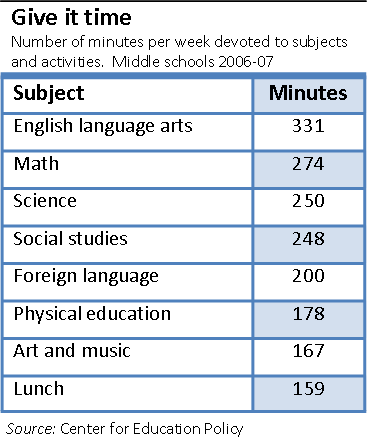 Where block-scheduling advocates move for ninety-minute sessions, Kansas advocates and extension of a mere fifteen minutes. The logic of block scheduling, Kansas argues, is based around lingering confusion; yet if the lesson were taught effectively the first time, the energy spent on the warm-up and review is reduced to accommodate time for a full lesson.
More specifically, measurable benefit from reduced class sizes was found in classes with less than eighteen students.[3],[i] This paper argues that one should look beyond class size, to take a look at the amount of time afforded to each child.
Indeed, the classroom’s chaos theory would have it that each increase in student causes more distraction and question, in turn necessitating more time to effectively teach each student. In a forty-five minute class with eighteen students, the average time allocated per pupil is 2.5 minutes. Under such a scenario, a class of 24 would require 60 minutes of class time.
One should – if taking into account the tendency of classroom chaos – analyze a progressive allocation. With eighteen students at 2.5 minutes per, the time allocated per student is equivalent to .14(per student). Under such scenario, a class of 24 would require 3.36 minutes per pupil, or 81 minutes per class.
This boundary of 60-80 minutes correlates with the times recommended by block-schedulers. If such an analysis of time proves to be an effective indicator, there are two prominent questions to determine the boundaries of effectives: one, what is the minimum amount of time required for a teacher to spend with one pupil; and two, at what point is the increase of time allocated per student no longer effective?
For these purposes, assume that it takes twenty-five minutes (excluding warm-ups and review) to teach a day’s lesson to one student. What one hopes to find is the total amount of time necessary to teach a class a lesson by utilizing 25 minutes as our base number for calculations and additions. Under the standard allocation, 1.1 minutes per student would be appropriate.
At 24 students, this amounts to a need for 26.4 extra minutes or 51.4 in total. Under the progressive system, .06 minutes per student/per student is allocated. With 24 students, this amounts to 1.44 minutes per student or 34.56 extra minutes needed, or 59.56 total.
The most critical question is at what point is the limit for effectiveness reached. It would seem to be capped at two hours if the extreme end of block scheduling formats and college lectures are any guide. The Chronicle of Higher Education has profiled a successful five-hundred person, seventy-five minute course at the University of Massachusetts; that, and an “unbearable” 600 person class, the differentiator is preparation.[4]
An endless year
Year-round schooling is the pariah of the time debate. Its proponents cite the continuity of learning and ability to stagger school schedules to accommodate more students. The opponents counter with diatribes on lost childhoods and worse still, worries over vacations. The reality is a lot less murky.
The traditional calendar was rooted in an era of farmers. (Indeed, your correspondent recalls various uncles’ and aunts’ tales of dreading rainy schooldays because they – and all other children of tobacco farmers – were called out early to the field.) The switch to year-round schooling was stalled against the demise of farming due to the lack of air conditioning, though it began its rise in the early 1900s – its popularity only newly found in the past two decades. As of 2000, three thousand schools had year-round formats – less than four percent of schools but far greater than it once was.[5]
Fears aside, students enrolled under year-round schooling spend the same amount of time in school as their peers with smaller, more frequent breaks in place. This offers hope to many that burn-out among teachers and students can be reduced. Its continuity also reduces the amount of time reviewing all that was lost during the summer – especially important for immigrants who lack constant exposure to English. Optimists look longingly at Japan’s 220 days enrolled in school (versus 180 for Americans) and their higher test scores.[6]
Several years back, many Texas districts converted to year-round schedules, only to swap back shortly thereafter. Their reasoning was a lack of performance increase – and (most likely) the strenuous fight against tradition. Oxnard, California districts, however, have been running year-round schedules since 1976 – with analysis showing broad improvement. Most criticism surround multi-track programs – which while reducing overcrowding, can strain families with children at different schools and complicate sporting events.[7]
Keep it in perspective
Since the advent of No Child Left Behind, nine percent of school districts have increased their elementary school day, whereas only one percent decreased their hours. The average change in increase or decrease amounts to little more than 18 minutes.[8] Indeed, while the cries for more time are now en vogue, one should note that net teaching time in American schools topped some 1,139 hours, compared with a norm of just around 800, only furthering the argument of the perils of bloated inefficiency.[9] All of which is enough to make you sympathize with Vladimir Nabokov: “I confess I do not believe in time.”
[1] The Power of Innovative Scheduling. Robert Lynn Canady. Educational Leadership. November 1995.
[2] About KIPP: The Five Pillars. KIPP.org. 2007. http://www.kipp.org/01/fivepillars.cfm.
[3] The New Reverse Class Struggle. Jay Matthews. Washington Post. 14 February 2006.
[4] Big, but Not Bad. Thomas Bartlett. The Chronicle of Higher Education. 9 May 2003. http://chronicle.com/free/v49/i35/35a01201.htm.
[5] Going to school year-round. Newshour Extra. 8 August 2001. http://www.pbs.org/newshour/extra/features/july-dec01/year-round.html
[6] Reasons to switch schedules. Ibid.
[7] Common drawbacks. Ibid.
[8] Choices, Changes, and Challenges: Curriculum and Instruction in the NCLB Era. Jennifer McMurrer. Center on Education Policy. 24 July 2007. http://tinyurl.com/35pkne.
[9] Teaching Time and Teachers’ Working Time. Education at a Glance 2004. OECD. 2004. http://tinyurl.com/2w75k.
[i] The figure does provoke debate. Joel Spring writes in American Education that “the optimum class size, according to the NEA, is fifteen students with lower numbers for students with exceptional needs.” Of course, “there is, however, another aspect to the goal of smaller class size, namely, improving teacher working conditions.” American Education. Joel Spring. Tenth Edition. McGraw Hill. 2002.
At the gate
International rankings
[You can view the PDF here.]
Independence is the essence of Kansas’ position – nationalized funding is but a secondary aim, albeit the potentially most effective for bringing about the full force of an incentives-based competitive market. This paper does not doubt the overall effectiveness of its schools reform platform if the means for financing it was altered to become the legally-bound responsibility of the state. A nationalized solution, then, is most pragmatic because it is less crippling locally and requires less political will to implement and follow-through.
One can also combat the negative correlation between centralized funding and schools performance on three fronts. Mexico, for better or worse, best embodies these trends.[11] First, geographic disparities naturally result in differences in the source of a schools funding. Smaller countries, e.g., Luxembourg, can more readily centralize funding.
[1] The World is Flat. Thomas L. Friedman. 2005.
[2] Full of woe. The Economist. 17 February 2007.
[3] The Complete List: The Top 100 Global Universities. Newsweek. http://www.msnbc.msn.com/id/14321230/. 13 August 2006.
[4] The Educated Child. William J. Bennett, Chester E. Finn, Jr., John T. E. Cribb, Jr.
[5] Reading Literacy of 15-year-olds. Education at a Glance 2004. OECD. http://tinyurl.com/2w7z5k.
[6] Average mathematics scale scores of eight-grade students, by country: 2003. Institute for Education Sciences. National Center for Education Statistics. U.S. Department of Education. http://tinyurl.com/2u7tmq.
[7] 15-year-olds’ Engagement in School – A Sense of Belonging and Participation. Education at a Glance 2004. OECD.
[8] Class Size and Ratio of Students to Teaching Staff. Ibid.
[9] Catching up. The Economist. 23 December 2006.
[10] Total Public Expenditure on Education. Education at a Glance 2004. OECD.
[11] Mexico’s mezzogiorno. Time to wake up. A survey of Mexico. The Economist. 18 November 2006.
[You can view the PDF here.]
Worry, Thomas Friedman tells Americans: The world is flat (forgive the advertisement) – and losing the Olympic basketball tournament is just the beginning. Standards of education are rising throughout the world, and as the country’s preeminence wanes, so go its substantial advantages.[1] After all, a globally competitive economy necessitates a globally competitive education. The United States, it seems, makes a solid performance, but leaves much to be desired, that is, depending on where one stands. It is, more than anything, a numbers game.
Many, with whom this paper agrees, would have the world’s richest economy be the best educated as well. (It, the United Nations ranks, is 12th out of 21 countries.)[2] Others, are more non-chalant: after all, of Newsweek’s top ten global universities, eight of ten are American.[3] The argument is at both points self-defeating and immediately beneficial to this paper’s quest for privatization. First, the gap between a poor education and superior economies does not bode well for long-term economic growth – the investment seems only capable of deteriorating; second, universities, private or autonomous, represent the ideal embodiment of a privatized schools system. Steven Sample, President of the University of Southern California, definitively concludes, “A country that has the best universities in the world has among the worst elementary and secondary schools.”[4]
Measuring the reading proficiency of fifteen year-olds, as measured by OECD, 61.1% of America’s students rank at or above Level 3 proficiency. This trails Japan’s level of 72% or Australia’s 68.6%. All told, fourteen of twenty-seven scores rank higher than the United States in terms of proficiency at the high end. More disconcerting, the percentage of the country’s pupils ranking at the bottom is 6.4%, more than mean of 6.0%, and greater than seventeen other nations.[5]
Many, with whom this paper agrees, would have the world’s richest economy be the best educated as well. (It, the United Nations ranks, is 12th out of 21 countries.)[2] Others, are more non-chalant: after all, of Newsweek’s top ten global universities, eight of ten are American.[3] The argument is at both points self-defeating and immediately beneficial to this paper’s quest for privatization. First, the gap between a poor education and superior economies does not bode well for long-term economic growth – the investment seems only capable of deteriorating; second, universities, private or autonomous, represent the ideal embodiment of a privatized schools system. Steven Sample, President of the University of Southern California, definitively concludes, “A country that has the best universities in the world has among the worst elementary and secondary schools.”[4]
Measuring the reading proficiency of fifteen year-olds, as measured by OECD, 61.1% of America’s students rank at or above Level 3 proficiency. This trails Japan’s level of 72% or Australia’s 68.6%. All told, fourteen of twenty-seven scores rank higher than the United States in terms of proficiency at the high end. More disconcerting, the percentage of the country’s pupils ranking at the bottom is 6.4%, more than mean of 6.0%, and greater than seventeen other nations.[5]
Math, as measured by the Department of Education’s Trends in International Mathematics and Science Study, te lls a similar tale: the country ranks 15th – only 8% above the mean, and trailing Singapore by 20 percent.[6]

Among the more interesting statistics, 25 and 20.2% of America’s students report a low sense of belonging and participation, respectively, also higher than the mean statistics for both benchmarks.[7] At 15.5 students to teachers at the pre-primary level, America is almost 5% higher than the mean; for all-secondary education, the country’s rank of 15.5 is some 14% above average. The country finds a rare success at the primary level where it has a ratio that is seven percent less than average. The country is notable for the near absolute stability of its ratio – the United Kingdom’s ratio ranges from 26.6 students per teacher to 12.5.[8] (This marked disadvantage for England’s primary-level children is remarkably clear: the cost, The Economist notes, of a child leaving English primary schools illiterate is some £50,000).[9]
Seeking the forest

Invariably, it does not take much to become muddled in statistics. Therefore, two points should be drawn in summary: higher centralized funding, as advocated in this paper, is negatively correlated with a country’s reading performance. (Only 8% of America’s school funding comes from the national government, whereas the mean is 50 percent.)[10] Schools independence, however, demonstrates a positive correlation (see chart). What then to make of the contradictory numbers in context of this paper’s argument; and what to weigh more?
Independence is the essence of Kansas’ position – nationalized funding is but a secondary aim, albeit the potentially most effective for bringing about the full force of an incentives-based competitive market. This paper does not doubt the overall effectiveness of its schools reform platform if the means for financing it was altered to become the legally-bound responsibility of the state. A nationalized solution, then, is most pragmatic because it is less crippling locally and requires less political will to implement and follow-through.
One can also combat the negative correlation between centralized funding and schools performance on three fronts. Mexico, for better or worse, best embodies these trends.[11] First, geographic disparities naturally result in differences in the source of a schools funding. Smaller countries, e.g., Luxembourg, can more readily centralize funding.
Yet, this difference in the source of funding does not differentiate between the level of resources available within and between countries: where the United States is relatively prosperous throughout its states, in countries like Mexico, where income distribution is not as equal, it is more pragmatic for a central government to step in. While central government spending may be high, it does not necessarily mean that it accounts for much, making such comparisons untidy.
Second, underlying factors regarding the nation’s economic development and the structure of its education system can skew results. Where economic conditions are bleak, the advantages of staying in school shrink. As a result, enrollment falls – or was never enforced – and performance deteriorates.
Third, general inefficiencies, a consistent target of this paper, could also be put into play. Mexico’s Educational Workers’ Union, the largest trade union in Latin America, has what The Economist terms “a stranglehold” on education funding. The union readily absorbs increased funding, and control of bad teachers, Enrique Rueda, director of Oaxaca's teachers, says is “very bad.” As a testament to the country's inefficiencies, public education spending as a percentage of all public expenditures in 2001 was marked at 18.0 – in excess of the mean of 8.9 percent – a territory it finds itself in with none other than the United States.
Second, underlying factors regarding the nation’s economic development and the structure of its education system can skew results. Where economic conditions are bleak, the advantages of staying in school shrink. As a result, enrollment falls – or was never enforced – and performance deteriorates.
Third, general inefficiencies, a consistent target of this paper, could also be put into play. Mexico’s Educational Workers’ Union, the largest trade union in Latin America, has what The Economist terms “a stranglehold” on education funding. The union readily absorbs increased funding, and control of bad teachers, Enrique Rueda, director of Oaxaca's teachers, says is “very bad.” As a testament to the country's inefficiencies, public education spending as a percentage of all public expenditures in 2001 was marked at 18.0 – in excess of the mean of 8.9 percent – a territory it finds itself in with none other than the United States.
[1] The World is Flat. Thomas L. Friedman. 2005.
[2] Full of woe. The Economist. 17 February 2007.
[3] The Complete List: The Top 100 Global Universities. Newsweek. http://www.msnbc.msn.com/id/14321230/. 13 August 2006.
[4] The Educated Child. William J. Bennett, Chester E. Finn, Jr., John T. E. Cribb, Jr.
[5] Reading Literacy of 15-year-olds. Education at a Glance 2004. OECD. http://tinyurl.com/2w7z5k.
[6] Average mathematics scale scores of eight-grade students, by country: 2003. Institute for Education Sciences. National Center for Education Statistics. U.S. Department of Education. http://tinyurl.com/2u7tmq.
[7] 15-year-olds’ Engagement in School – A Sense of Belonging and Participation. Education at a Glance 2004. OECD.
[8] Class Size and Ratio of Students to Teaching Staff. Ibid.
[9] Catching up. The Economist. 23 December 2006.
[10] Total Public Expenditure on Education. Education at a Glance 2004. OECD.
[11] Mexico’s mezzogiorno. Time to wake up. A survey of Mexico. The Economist. 18 November 2006.
The everyman
Education polls
Fifty-eight percent of respondents believe that the local school board should have the greatest influence, followed by 26% in favor of state, and 14% in favor of the federal government. Incidentally, when asked of the biggest impetus for teachers leaving their profession: 96% believe that the lack of parental support is very or somewhat important, a sentiment shared by teachers in Joel Spring’s analysis of American education.[3]
Teaching and testing
In terms of curriculum, 58% of respondents (a 31% increase over 44% in 1979) believe that a wide variety of courses should be available. Respondents are nearly split, by 47-44% in believing that the curriculum needs to be changed to meet “today’s needs” and those who believe it already meets those needs respectively. The percentage who agree that the school curriculum needs to be changed, has increased a striking 51% from 31% in 1970.
When asked of testing, 39% of respondents believed that there was too much emphasis on achievement testing in public schools, an emphasis that 67% of those who agree believe will encourage teachers to teach to the test, of which 75% believe is a bad thing. All the same, 63% of respondents are in favor of a mandatory high-school exit exam.
Thinking about reform
Revealingly, Time respondents split evenly on the effect of the No Child Left Behind Act – 35% each viewing the law’s impact as positive or minimal. Twenty-three percent viewed the act’s impact negatively. Phi Delta Kappa’s findings on school reform are rather ambiguous: 71% of respondents support reforming the existing education system, whereas 24% support finding an “alternative” system. The distinction between “reform” and “alternative” is distressingly unclear to draw any decisive conclusions. Kansas would describe its proposal as reform within the existing system – preserving the ideal of empowering public schooling by reforming the means by which it is realized through enhanced autonomy.
All the same, it would appear to be a difficult argument to make: 60% of PDK respondents oppose voucher programs, and only a slim majority of 53% support charter schooling. Kansas stresses that the opposition is directed towards a two-tier system of public and private schooling, an opposition that is shared by this paper. Kansas stridently defines public education as free – in cost and autonomy, meritocratic, and equal. These ideals are the heart of the paper’s proposals. The apparent hostility to reform is nonexistent and muddled inferences irrelevant.
Doing something
Forty-nine percent of respondents agree that preschool programs for children from low-income and poverty-level households would do a great deal of benefit. Crucially, sixty-six percent would agree to more taxes to such programs, a sentiment that is echoed broadly in Time’s general measure of support by a margin of 59-38 percent.
Some fifty-seven and 73% of respondents believe that elementary and high school students are not working hard enough. Forty-nine versus 48% oppose increasing the amount of the school day. Of those who support increasing the school day, 66% over 31% support increasing the school year over the school day, but 67% would support increasing the school day by one hour.
[1] PDK/Gallup Polls of the Public’s Attitudes Toward the Public Schools. http://www.pdkintl.org/kappan/kpollpdf.htm.
[2] Time-Oprah Winfrey Show Poll. March 2006. http://www.oprah.com/tows/pastshows/200604/tows_past_20060411_c.jhtml
[3] The Rewards of Teaching. The Profession of Teaching. American Education. Joel Spring. Tenth Edition. McGrawHill. 2002. Page 40.
Each year, for thirty-eight years, Phi Delta Kappa, an education journal and Gallup, a pollster, have sought to capture a “continuing analysis of public opinion in American education” since its first poll in 1968. The findings offer a unique perspective on education and the everyman.[1] An analysis:
No problem here
One of the most striking results is the disparity between the perception of local schools and the nation. Forty-nine percent of parents give their local schools a rating of an A or B, but nationally only twenty-one percent of parents concur. The national majority of fifty-one percent is inclined heavily towards a C. Parents attribute the largest problem facing public schools to a lack of funding (24%), trailed by overcrowded schools (13%), and lack of discipline (11%).
The conclusion, captured by Time, is that more than 55% of the public is dissatisfied with the nation’s schools; a sobering 61% believe schools are in crisis – with 52% believing that schools are worse than they were twenty years ago.[2] When asked where the United States ranks internationally, the response was uncharacteristically unsettled (see chart).
The achievement gap
A resounding 88% of respondents agree that closing the minority achievement gap is very or somewhat important, and 81% agree that the gap can be narrowed “substantially” while keeping high standards in place. Fifty-seven percent of respondents believe that it is the responsibility of public schools to close the achievement gap. The results on this front are rather disconcerting: only 49% of public school parents agree whereas 60% of adults with no children in school do. Among parents with children in school, those who believe that it is the responsibility of schools to close the gap, their 49% is nearly balanced by the 46% of parents who disagree.
Who’s the boss, boss?
No problem here
One of the most striking results is the disparity between the perception of local schools and the nation. Forty-nine percent of parents give their local schools a rating of an A or B, but nationally only twenty-one percent of parents concur. The national majority of fifty-one percent is inclined heavily towards a C. Parents attribute the largest problem facing public schools to a lack of funding (24%), trailed by overcrowded schools (13%), and lack of discipline (11%).
The conclusion, captured by Time, is that more than 55% of the public is dissatisfied with the nation’s schools; a sobering 61% believe schools are in crisis – with 52% believing that schools are worse than they were twenty years ago.[2] When asked where the United States ranks internationally, the response was uncharacteristically unsettled (see chart).
The achievement gap
A resounding 88% of respondents agree that closing the minority achievement gap is very or somewhat important, and 81% agree that the gap can be narrowed “substantially” while keeping high standards in place. Fifty-seven percent of respondents believe that it is the responsibility of public schools to close the achievement gap. The results on this front are rather disconcerting: only 49% of public school parents agree whereas 60% of adults with no children in school do. Among parents with children in school, those who believe that it is the responsibility of schools to close the gap, their 49% is nearly balanced by the 46% of parents who disagree.
Who’s the boss, boss?

Fifty-eight percent of respondents believe that the local school board should have the greatest influence, followed by 26% in favor of state, and 14% in favor of the federal government. Incidentally, when asked of the biggest impetus for teachers leaving their profession: 96% believe that the lack of parental support is very or somewhat important, a sentiment shared by teachers in Joel Spring’s analysis of American education.[3]
Teaching and testing
In terms of curriculum, 58% of respondents (a 31% increase over 44% in 1979) believe that a wide variety of courses should be available. Respondents are nearly split, by 47-44% in believing that the curriculum needs to be changed to meet “today’s needs” and those who believe it already meets those needs respectively. The percentage who agree that the school curriculum needs to be changed, has increased a striking 51% from 31% in 1970.
When asked of testing, 39% of respondents believed that there was too much emphasis on achievement testing in public schools, an emphasis that 67% of those who agree believe will encourage teachers to teach to the test, of which 75% believe is a bad thing. All the same, 63% of respondents are in favor of a mandatory high-school exit exam.
Thinking about reform
Revealingly, Time respondents split evenly on the effect of the No Child Left Behind Act – 35% each viewing the law’s impact as positive or minimal. Twenty-three percent viewed the act’s impact negatively. Phi Delta Kappa’s findings on school reform are rather ambiguous: 71% of respondents support reforming the existing education system, whereas 24% support finding an “alternative” system. The distinction between “reform” and “alternative” is distressingly unclear to draw any decisive conclusions. Kansas would describe its proposal as reform within the existing system – preserving the ideal of empowering public schooling by reforming the means by which it is realized through enhanced autonomy.
All the same, it would appear to be a difficult argument to make: 60% of PDK respondents oppose voucher programs, and only a slim majority of 53% support charter schooling. Kansas stresses that the opposition is directed towards a two-tier system of public and private schooling, an opposition that is shared by this paper. Kansas stridently defines public education as free – in cost and autonomy, meritocratic, and equal. These ideals are the heart of the paper’s proposals. The apparent hostility to reform is nonexistent and muddled inferences irrelevant.
Doing something
Forty-nine percent of respondents agree that preschool programs for children from low-income and poverty-level households would do a great deal of benefit. Crucially, sixty-six percent would agree to more taxes to such programs, a sentiment that is echoed broadly in Time’s general measure of support by a margin of 59-38 percent.
Some fifty-seven and 73% of respondents believe that elementary and high school students are not working hard enough. Forty-nine versus 48% oppose increasing the amount of the school day. Of those who support increasing the school day, 66% over 31% support increasing the school year over the school day, but 67% would support increasing the school day by one hour.
[1] PDK/Gallup Polls of the Public’s Attitudes Toward the Public Schools. http://www.pdkintl.org/kappan/kpollpdf.htm.
[2] Time-Oprah Winfrey Show Poll. March 2006. http://www.oprah.com/tows/pastshows/200604/tows_past_20060411_c.jhtml
[3] The Rewards of Teaching. The Profession of Teaching. American Education. Joel Spring. Tenth Edition. McGrawHill. 2002. Page 40.
The cast of characters
The people of schools reform
[You can view the PDF here.]
[You can view the PDF here.]
As a senior at Princeton University, Wendy Kopp proposed a national teacher corps in the aim of eliminating educational inequality. Shortly thereafter, with $2.5 million in funding and a “skeleton” staff such a corps came into being. Ms Kopp’s corps, Teach For America, began its first year in 1990, with 500 men and women serving six low-income communities across the country. Seventeen years on, the acclaimed program has reached some 2.5 million students, in now 25 regions, with 4,400 current members and 12,000 alumni.1 “We believe that all children have the potential to achieve,” the corps’ mission explains, “and that all educational inequity stems from broader structural and societal problems.”2
That something is terribly amiss is a shared sentiment among the political and intellectual divide. Strong American Schools, a nonpartisan public awareness and action campaign, is promoting as its centerpiece Ed in ‘o8. The group, funded by the Rockefeller Philanthropy Advisors and Bill & Melinda Gates and Eli & Edythe Broad Foundations, declares that “America’s students are losing out,” and hopes that presidential candidates offer much more than “empty rhetoric” in elaborating on their three foci on education standards, effective teachers, and giving students more time and support for learning.3
Indeed, for better or for worse, it is in politics where the greatest power is wielded. There are plenty who look upon power as promise, and just as many who would rather see it fail. First, the protagonists.
The ayes of Roll Call 145
“I strongly condemn an achievement gap that exists in this country,” President George Bush passionately explained after a “fascinating” spring meeting with the nation’s education, civil rights, and business leaders. True to form, the President went on to deadpan that he believes his signature No Child Left Behind Act needs to be reauthorized “because it's working.”4 The program’s May 2001 passage was a striking bipartisan feat, united in broad agreement with “what the law is trying to do,” writer Linda Perlstein explains.5,6 “Glum ‘buts’” soon followed.
The ‘buts’ are wildly, and distressingly contradictory, in lamentation of impossible rigidity, a view shared widely among educators, and illogical flexibility, shared by commentators.[i] President Bush straddled a delicate argument in securing the bill’s first passage with what many conservatives viewed as a distressing impediment by federal government into their revered states’ rights. The vote is telling: Republican votes managed only 5 ½ votes in favor for every dissenting one, where the Democrats achieved nearly 20 to one.
The law finds its origins in the standards-based reform movement. It began in the 1990s with an emphasis on “having clear and high content and performance standards for students” with curriculum and assessments in line.7 Students, the thinking has it, will rise to meet high expectations, just as easily as they will effortlessly fall to meet lower ones.
As for whether the program is working, the evidence, while fleeting, aligns itself decisively in the President’s favor. The Center on Education Policy’s June 2007 report, Answering the Question that Matters Most, details that states with three or more years of comparable test data have shown increased student achievement in reading and math since 2002 – the year No Child was enacted. Further, achievement gaps between students have been narrowing, if remaining undesirably “substantial.” Most tellingly, nine of the thirteen states with sufficient data to determine trends before and after the law was enacted shows that average yearly gains in scores were greater after No Child took effect than before.[8],[ii]
Yet the trouble arises as the report concludes that it is “difficult, if not impossible” to determine the extent that NCLB has caused these trends as states and schools have all simultaneously released different, but interconnected policies to raise achievement. All the same, the law – loftiest goals aside – was no more than the spur for states to carry out such initiatives. The conclusions, then, are encouraging. Tracy McDaniel, a national board member for the Knowledge is Power Program, is clear: “I think the greatest impact of No Child Left Behind has been to serve as a catalyst for innovation and excellence in public education.”[9]
The ink barons
A survey of major newspapers would find broad agreement with the duality of a federal framework and greater autonomy for schools. The Washington Post editorializes its fear that No Child is “in the crosshairs,” analogizing that one would not “demolish his home because it had a leaky basement or it needed new carpeting.” Were it not for the law, the paper goes on to say, failure would continue without consequence, the achievement gap would remain irrelevant, and parents would remain powerless to ensure their children a better education where their schools have failed them. Strengthen the law, the paper argues. No one claims it won’t be hard.10,11
It is The Wall Street Journal, founded in the interests of “free markets and free people,” that advocates for school choice.12 It champions economist Milton Friedman’s belief that “empowering parents would generate a competitive education market, which would lead to a burst of innovation and improvement, as competition has done is so many other areas.”13
Both the New York Times and Washington Post have supported their respective mayor’s moves for school reform; the Times particularly impressed with the City’s “impressive strides toward the goal of replacing large and often dysfunctional factory-style high schools with smaller schools.”14 The Economist, commenting particularly on British schools, but its principles universal, believes that “competition and freedom in education, as elsewhere, are the way to encourage innovation and raise standards for all.”15 That four of the nation’s most influential newspapers are so strongly aligned with the duality of education reform speaks to a strong reservoir of support that is awaiting a thoughtful comprehensive reform plan.
Enter the foils
“Republicans voted for No Child Left Behind holding their noses,” a critic of the legislation told the Washington Post.16 With the executive branch’s political capital severely marginalized, legislators are beginning to, in the words of an old folk song “making their own kind of music.” The tune would be to allowing states to opt out of the law’s testing mandates; the lyricist being suburban and exurban districts that look upon the law’s mandates with dismay – seeing the crippling of programs for the gifted and talented and the discouragement of creativity in their schools.
A recent report by the Center on Education Policy finds that 62% of districts have increased time for English and mathematics classes since No Child was enacted; it is the 44% percent of districts that have reduced time in social studies, sciences, arts, physical education, lunch, and recess that has elicited such ire.17.iii Their frustration is merited – and captured frequently within this paper. The No Child Left Behind Act succeeds precisely because it is not a reckless, crippling expectation of “legislated excellence.”18
Elsewhere, others disdain the increasing unrealism surrounding demands for 100 percent proficiency by 2014. It is an understandable, but not respectable criticism. Muddling the clarity of the law’s aim of adequate yearly progress through variables that essentially “let schools off the hook” through different measures, as Kati Haycock, president of the Education Trust writes, threatens to obscure what the law has “uncovered” Secretary of Education, Margaret Spelling concurs in a Washington Post symposium.[19]
Yet, as the threats ceaselessly mount against the law, an opportunity, consistent with that of this paper arises. If the act is looked upon as the first venture into a nationalized framework for reform, the discontent arises not out of hostility to its aims, but out of a desire to move forward in bringing about the duality of a national framework and autonomous schooling. It is here that the small but crucially necessary reforms, especially relevant for students for whom English is a second language, can be made.
The law, as a transitional framework, parallels that of the short-lived Articles of Confederation. The increasing desire for further reform reveals the law’s role as an interim means of furthering this duality.[20] It is an audacious effort, but not inconsistent with the pursuit of an equitable, lively, meritocratic education.
Indeed, amidst the discontentment, it is the ideal time to begin repositioning the education debate towards autonomy. The risk of abandoning states and schools to their own means threatens to impede the fulfillment of a lasting platform for intellectual development. The risk of returning to decades more of idle reform – teetering back and forth between empty rhetoric and vacuous technique – is not one to entertain.
[1] Our history. Teach for America. 5 July 2007. http://www.teachforamerica.org/about/our_history.htm.
[2] Theory of change. Teach for America. 5 July 2007. http://www.teachforamerica.org/mission/theory_of_change.htm.
[3] About us. Ed in ’08. Strong American Schools. 5 July 2007. http://www.edin08.com/AboutUs.aspx.
[4] President Bush Discusses the Reauthorization of the No Child Left Behind Act. The White House. 12 April 2007. http://whitehouse.gov/news/releases/2007/04/20070412.html#.
[5] Final Vote Results For Roll Call 145. United States House of Representatives. http://clerk.house.gov/evs/2001/roll145.xml.
[6] The Issue Left Behind. Linda Perlstein. The Nation. 21 October 2004. http://www.thenation.com/doc/20041108/perlstein.
[7] A Call for High Standards & Systemic Reform. American Federation of Teachers. 6 July 2007. http://www.aft.org/topics/sbr/index.htm.
[8] Answering the Question That Matters Most. Has Student Achievement Increased Since No Child Left Behind? Center on Education Policy. June 2007. http://tinyurl.com/38o4rg.
[9] Leaving No Child Behind. Tracy McDaniel, et al. A symposium. The Washington Post. 10 September 2007.
[10] ‘No Child’ in the Crosshairs. Editorial. The Washington Post. 2 July 2007.
[11] A Vote for ‘No Child’. Editorial. The Washington Post. 7 August 2007.
[12] Our philosophy. About Us. Opinion Journal. The Wall Street Journal Editorial Page. http://www.opinionjournal.com/about/philosophy.html.
[13] School-Choice Strategy. Howard S. Rich. Opinion. The Wall Street Journal. 16-17 June 2007.
[14] Smaller, Better High Schools. Editorial. The New York Times. 6 July 207.
[15] The S-word. The Economist. Leaders. 26 May 2007.
[16] Dozens in GOP Turn Against Bush’s Prized ‘No Child’ Act. Jonathan Weisman, Amit R. Paley. Washington Post. 15 March 2007. http://tinyurl.com/2r9v4f.
[17] Choices, Changes, and Challenges: Curriculum and Instruction in the NCLB Era. Jennifer McMurrer. Center on Education Policy. 24 July 2007. http://tinyurl.com/35pkne.
[18] Schools That Work: America’s Most Innovative Public Education Programs. George H. Wood, Ph.D. Penguin Books. 1992.
[19] Leaving No Child Behind. Margaret Spellings, Reg Weaver, Kati Haycock, Jack Dale, Michael R. Bloomberg, George Miller, Jason Kamras, Andrea Peterson, Tracy McDaniel. The Washington Post. 10 September 2007.
[20] Several prominent schools superintendents are now disclosing their support for national standards. Jack Dale, superintendent of Maryland’s leading Fairfax county schools, “would advocate for a federal testing system that allows comparison across states and … school districts. … Unless we create a quality, integrated system with clear roles and responsibilities, we will instead create an incoherent, contradictory and inconsistent educational system in the U.S.” Schools Chiefs Suggest Fixes for ‘No Child.’ Jay Mathews. The Washington Post. 1 October 2007.
[i] “In May, two-thirds of Pennsylvania’s superintendents signed a statement protesting the law’s rigidity, and seven in ten Connecticut superintendents said the law’s sanctions harm struggling schools instead of helping them, according to a survey released last week. National organizations, such as the National Council of Teachers of English and the NAACP, echo the concerns.” The Issue Left Behind. Linda Perlstein. The Nation. 21 October 2004. http://www.thenation.com/doc/20041108/perlstein.
[ii] The report also concluded, “more attention should be given to the issues of the quality and transparency of state test data.” It recognizes that tests are an “imperfect measure” of achievement.
[iii] The report notes a 31 percent reduction in the total instructional time devoted to social studies, science, art and music, physical education, lunch and/or recess since 2001-02. The report recommends staggering testing requirements to include more academic subjects and encouraging states to give “adequate emphasis” to the arts.
Keeping your monster on a leash
School accountability
Perhaps the most significant criticism of the No Child Left Behind Act has been what opponents portray as the unjustifiably exclusive use of testing as the sole benchmark for school progress. [1] Among the alternative measures proposed include graduation rates, AP course enrollment, as well as achievement in the arts, history, and sciences.
Kansas posits that three elements are crucial to a succesful accountability system: short-term flexibility that allows schools to close their relative achievement gaps without incurring penalty following the initial reform, a payments and ratings system that recognizes the confluence of multiple factors in succesful schools, as well as a framework for school improvement.
In the system that this paper proposes, mild decreases in test performance are largely irrelevant to a school's standing: district's will make their assessments on renewing a school's term principally on an overall rating system that accounts for a variety of factors. Only schools that suffer sharp decreases or chronic nonperformance, will trigger direct action by the district.
Small drops that last for two to three years, should be expected at least once per decade in all schools - as a result, the consequences are reasoned - encouraging the review of school curriculum and policies by a school improvement team composed of persons chosen by the school and district in question. Such a system is by no means intended to cause institutional shame, but as necessary as one would need to consult a mechanic if their car fails.
The length of the five-year transformation period is justified by a recent study on comprehensive school reform. The study found that “schoolwide changes take three to five years to bear fruit and that fidelity to the program is key to success.”[2]
Ratings
Maintaining credibility
Send in the army
The ultimate goal of privatization is that school success, standards, and opportunities will expand in accordance with market expectations. As schools can no longer afford to fail, given students' liberty to transfer elsewhere, and also the liberty to change operations, schools must compete to provide the best education. Markets allow for the implementation of reasoned, progressive incentives, particularly promising in encouraging good schools to recruit poor-performing or disabled students.
[1] Calls Grow for a Broader Yardstick for Schools. Maria Glod. The Washington Post. 16 December 2007.
[2] In Whole-School Reform, Staying True to Model Matters. Debra Viadero. Education Week. 14 May 2007. http://tinyurl.com/38anl5.
Perhaps the most significant criticism of the No Child Left Behind Act has been what opponents portray as the unjustifiably exclusive use of testing as the sole benchmark for school progress. [1] Among the alternative measures proposed include graduation rates, AP course enrollment, as well as achievement in the arts, history, and sciences.
Kansas posits that three elements are crucial to a succesful accountability system: short-term flexibility that allows schools to close their relative achievement gaps without incurring penalty following the initial reform, a payments and ratings system that recognizes the confluence of multiple factors in succesful schools, as well as a framework for school improvement.
In the system that this paper proposes, mild decreases in test performance are largely irrelevant to a school's standing: district's will make their assessments on renewing a school's term principally on an overall rating system that accounts for a variety of factors. Only schools that suffer sharp decreases or chronic nonperformance, will trigger direct action by the district.
Small drops that last for two to three years, should be expected at least once per decade in all schools - as a result, the consequences are reasoned - encouraging the review of school curriculum and policies by a school improvement team composed of persons chosen by the school and district in question. Such a system is by no means intended to cause institutional shame, but as necessary as one would need to consult a mechanic if their car fails.
7.1 In the five years immediately following privatization, failing schools are expected to make adequate progress towards national standards. A school with a current level 54% of students at exceptional to superior, for example, would need to improve their marks by 4.2 percentage points per year.
The length of the five-year transformation period is justified by a recent study on comprehensive school reform. The study found that “schoolwide changes take three to five years to bear fruit and that fidelity to the program is key to success.”[2]
7.2 Following this period, schools must maintain national standards, and must not fail to meet them for two consecutive years, or they will be required to consult a school improvement team.
Ratings
7.3 The means for assessing a school’s performance will be based largely on a compilation of ratings. For example, a school may possibly achieve ten stars: 2 each for math and reading performance (a 70% pass rate on each equals 2.8), 2 for graduation rate, 1 for science and history performance, 1 for art, 1 for AP enrollment, and 1 as a challenge index (the voluntary recruitment of disabled, or poor-performing students).
The purpose of this rating system allows for a more complete assessment of a school's performance - of which test performance is an important factor that can be offset by improvements elsewhere.
7.4 Every school must publish this information, and districts must provide the data for each school to all parents. These key performance indicators must be used with the intent of establishing a panorama of school performance from a credible variety of vantage points. Additionally, a national ranking for elementary and secondary schools will be produced annually.
Maintaining credibility
7.4 The district will serve as the coordinator of schools enrollment as they lack any direct benefit from data manipulation of dropout statistics.
7.5 Schools will be required following the five-year interim period to have digital testing centers, ideally in the form factor of tablet personal computers, for direct, digital assessments to maintain the integrity of testing. Such a format also offers the benefits of on-demand access and incorporating assistance for special-needs students.
Send in the army
7.6 If a school should fail to meet standards, the district will be expected to dispatch a focus group of five to ten highly trained persons to develop a plan of acceptable change in close coordination with the school’s staff and parents. Parents would vote on such a plan.The market
7.7 If a school reaches a state of chronic failure, the focus group would assume full operational control of the school, including personnel, with the exception of
the school’s focus—be it traditional, art, religious education, etc.
7.8 The nature of a school’s format will be reviewed by the district for all schools every five years. At this time, the district would initiate the process for significantly reforming poor-performing schools—soliciting bids as well as reviewing options for establishing independent schools, whose initial management is chosen directly by the district.
The ultimate goal of privatization is that school success, standards, and opportunities will expand in accordance with market expectations. As schools can no longer afford to fail, given students' liberty to transfer elsewhere, and also the liberty to change operations, schools must compete to provide the best education. Markets allow for the implementation of reasoned, progressive incentives, particularly promising in encouraging good schools to recruit poor-performing or disabled students.
[1] Calls Grow for a Broader Yardstick for Schools. Maria Glod. The Washington Post. 16 December 2007.
[2] In Whole-School Reform, Staying True to Model Matters. Debra Viadero. Education Week. 14 May 2007. http://tinyurl.com/38anl5.
Making the most of partners
To face the myriad of conflicts facing schools, public or privatized, an emphasis on integrating the funds and services of relevant partners will be essential in maximizing services.
These partners deserve significant flexibility consistent with their own goals; the government should be reduced to providing national frameworks and standardized systems for the allocation of resources. Comprehensive measuring will be necessary to meet the demands of many organizations who seek to measure the direct impact of their contributions.
Dynamic labor force
Scholarships
Colleges
Advanced placement programs
An all together different marketplace of ideas
In the meantime, schools have dithered on in countless endeavors in the pursuit of a harmonious society. Moral education brings with it a myriad of controversies – be it sexual and drugs education, community service, and, rather amusingly, marriage courses.[2] Driver’s education has never been duller.
Such additions to the classroom are – while admirable in aim – distracting in effect. Less clutter and more focus couldn’t be more welcome to classrooms, yet the barrage of special interests is firmly rooted. An autonomous schools system as proposed by this paper would be less entangled. Alongside the more rigorous voluntary national, state, and local curriculums, Kansas proposes that all but critical health programs are limited to a voluntary status. Governments would be free to incentivize such teaching to fund textbooks and resources as they will. Such a system inverts the relationship between school and government, offering schools the flexibility to offer distinctive programs and courses – organic gardening, perhaps – that appeal to their students.
This framework would also add much needed transparency to the murky world of what to teach. Organizations and companies alike can construct a curriculum that, if vetted by local school districts, could be added to the list of voluntary curriculums – contributing resources as they choose. It, while undesirable, is already being done: look closely at your child’s worksheets bordered with candies.[3] As long as the involvement is disclosed, schools walk this avenue at their own peril. Even then, such debates pails in comparison to the far more important ones competing to demonstrate how effectively they can spur intellectual development. Schools deciding on KIPP or International Baccalaureate structures – or charting their own course – with passion and adequate resource are the essential feature. Everything else promises to be, at best, good fun for the cynical observer. How long until Acme’s Comprehensive Scrapbooking Course remains to be seen. Scrapbooking, is an art – isn’t it?
[1] Costs begin before college. Alvin P. Sanoff. USA Today. 7 February 2005. http://www.usatoday.com/news/education/2005-02-06-college-costs_x.htm
[2] Ibid. Page 4.
[3] Don’t Eat This Book. Fast Food and The Supersizing of America. Morgan Spurlock. Putnam Adult. 2005.
These partners deserve significant flexibility consistent with their own goals; the government should be reduced to providing national frameworks and standardized systems for the allocation of resources. Comprehensive measuring will be necessary to meet the demands of many organizations who seek to measure the direct impact of their contributions.
Dynamic labor force
6.1 One potential partner will be utilizing networks of teachers, similar to the services provided by Teach for America. Scaled nationally, the organization can serve as a dynamic agency for directing resources to regions most in need, serve as valuable base for long term recruitment and training.
6.2 Similarly, schools would be encouraged to implement volunteers—paid, unpaid, or as part of a broadened Teach for America system—in their classroom. Functioning as readers, assistants, or a portion of management, such partners would significantly reduce costs and expand opportunities for teachers. Assistants with basic training could significantly impact the student to teacher ratio. A specific opportunity is in allowing schools to hire qualified retirees to teach courses relevant to their experience - an effort to engage schools in the transfer of the retiree knowledge base.
Scholarships
Schools6.3 The most common form of partner integration will be in the establishment of scholarships for university education. The system can take a variety of forms—a likely course will be the establishment of a national database of student performance and activities, available in a manner that does not compromise privacy, allowing potential donors to filter potential prospects and contribute in a streamlined process to a student’s education account. This is more an opportunity for existing services to partner further with schools and students than it is an adovcacy of a new framework.
6.4 Some persons and institutions will prefer to establish their own private schools, fully or significantly without government contribution. Other institutions will prefer implementing programs within established schools for niche interests. They must continue to adhere to basic federal curriculum standards.
Colleges
6.5 Where available, schools will integrate with community colleges to allow students to complete a portion of their workload prior to graduation; additionally, some large colleges may initiate distance-learning programs in high schools—available on a free or highly reduced basis.Foreign language
6.6 Preparatory schools may utilize discretionary funds for extensive college application assistance including subsidizing application fees.
6.7 Schools should also seek to partner with foreign nations in supplementing America’s foreign education teacher base with native speakers—especially in areas with little exposure in the country, like Mandarin or Arabic.
Advanced placement programs
6.8 Schools will be encouraged to offer courses aligned with the College Board’s Advanced Placement standards.Such subsidization can ameliorate cost concerns for students that can often limit students’ ability to engage fully in the college application process due to fees or costs of visiting campuses.[1]
6.9 Schools may subsidize or completely pay for the costs of taking the tests as a perquisite designed to attract students.
6.10 Preparatory focus schools may also pay for and require that their students take additional examinations such as the ACT and SAT to enhance competiveness.
An all together different marketplace of ideas
In the meantime, schools have dithered on in countless endeavors in the pursuit of a harmonious society. Moral education brings with it a myriad of controversies – be it sexual and drugs education, community service, and, rather amusingly, marriage courses.[2] Driver’s education has never been duller.
Such additions to the classroom are – while admirable in aim – distracting in effect. Less clutter and more focus couldn’t be more welcome to classrooms, yet the barrage of special interests is firmly rooted. An autonomous schools system as proposed by this paper would be less entangled. Alongside the more rigorous voluntary national, state, and local curriculums, Kansas proposes that all but critical health programs are limited to a voluntary status. Governments would be free to incentivize such teaching to fund textbooks and resources as they will. Such a system inverts the relationship between school and government, offering schools the flexibility to offer distinctive programs and courses – organic gardening, perhaps – that appeal to their students.
This framework would also add much needed transparency to the murky world of what to teach. Organizations and companies alike can construct a curriculum that, if vetted by local school districts, could be added to the list of voluntary curriculums – contributing resources as they choose. It, while undesirable, is already being done: look closely at your child’s worksheets bordered with candies.[3] As long as the involvement is disclosed, schools walk this avenue at their own peril. Even then, such debates pails in comparison to the far more important ones competing to demonstrate how effectively they can spur intellectual development. Schools deciding on KIPP or International Baccalaureate structures – or charting their own course – with passion and adequate resource are the essential feature. Everything else promises to be, at best, good fun for the cynical observer. How long until Acme’s Comprehensive Scrapbooking Course remains to be seen. Scrapbooking, is an art – isn’t it?
[1] Costs begin before college. Alvin P. Sanoff. USA Today. 7 February 2005. http://www.usatoday.com/news/education/2005-02-06-college-costs_x.htm
[2] Ibid. Page 4.
[3] Don’t Eat This Book. Fast Food and The Supersizing of America. Morgan Spurlock. Putnam Adult. 2005.
The many faces of education
School formats
Variations
5.1 Schools will be divided into several key formats based on the breadth and depth of their curriculum:
5.1.a Traditional schools.
5.1.b Arts schools.
5.1.c Vocational secondary schools.
5.1.d Montessori schools.
5.1.e Focus schools—including science and technology, mathematics, literature, preparatory schools, et al. Additionally, schools may be organized on matters including religious curriculum and gender exclusivity.[i]
Traditional schools would remain most similar to the norm—their offerings would include the arts, but focus more on breadth of studies.
The school curriculum
5.2 Building from the basic, national curriculum of competencies, schools will develop their own comprehensive curriculum consistent with their format and philosophy. These conceptions may include:
5.2.a The traditional measured conceptualization, in which behavioral objectives, sequential learning, skills and content mastery, and teacher accountability are the essential tenants.[1]
5.2.b The academic rationalism conceptualization, which is subject-centered in design.[2]
5.2.c The cognitive processes conceptualization, which emphasizes the “ability to think, reason, and engage in problem-solving activities.”[3]
5.2.d The social reconstruction conceptualization, which believes that the “problems and dilemmas of society are what ought to be studied by students with the intent of creating amore just, equitable and humane society.”[4]
5.2.e The self-actualization conceptualization, in which “students become the curriculum developers, selecting for study what they are interested in, intrigued by, and curious about.”[5]
Such conceptualizations will correlate strongly along a spectrum of “traditional” to “progressive” schooling.
Variations
5.3 Among even schools of the same types, there will be variations of initiatives—some may pursue microsocieties or teaming where others may pursue adherence to a KIPP or International Baccalaureate structure. Schools will also have the option of expanding its market by serving the role of boarding school.
Organizational structure
5.4 School flexibility will enable additional opportunities for implementing divergent approaches on school management. Some schools tied only to one group of grade-levels will maintain a traditional principal and secondary assistant’s role. Other schools that span elementary and secondary levels may group grades under multiple principles.
In fact, it will be encouraged that schools encompass all grades to promote greater investments in primary education.
5.5 The basic support staff for schools will consist of counselor and secretary, expanding as the complexity of the organization grows. To avoid constrictive costs, most schools will effectively utilize teachers to oversee matters of individual school curriculum in coordination with the district versus hiring specialized managers.
5.6 A basic system for oversight will involve a board of parents and teachers, who will oversee the hiring and pay of teachers, pay and bonuses. It is desirable that the role of such systems is to prevent irresponsible management—not manage.
5.7 The government will fully finance home school students’ Advanced Placement and college preparatory assessments.
Home schools
5.8 Home schools will remain subject to individual state standards.
5.9 Once home school students have reached the age of fourteen, students must sit for the national tests of basic mastery tests in reading and mathematics. Parent and student are at liberty to extend the degree of examination to encompass greater difficulty or additional subjects.
5.10 Parents will be encouraged to have their students sit for basic examinations prior to reaching high school age by a reimbursement of $2,500 for exceptional scores (85-100%).
Partnerships
5.11 In a strive for efficiency, schools will be encouraged to collaborate with other schools to assist in providing a full educational experience. Traditional schools collaborating with vocational or arts schools in the latter years of a child’s education would be common.
Encouraging innovation
5.12 The essence of school privatization is the ability for all schools to commit itself to a core set of aims with minimal influence from competing initiatives. It is key that sound, new ideas regarding education continue to be developed and implemented throughout the country.
5.13 Colleges may establish their own schools to perform pilots, which may also be an effective means for preparing new teachers. Passionate groups may do likewise.
A recent report demonstrates the velocity of the diffusion of innovation between schools. The lead author acknowledges, “What schools perceive as good ideas in comprehensive school reform spread quickly to other schools.”[6] The result is that schools need not all be like the Crested Butte Academy, a private high school for snowboarders in Denver, Colorado – simply getting the job done works too.[7]
[1] Alternative Curriculum Conceptions and Designs. M. Frances Klein. Contemporary Issues in Curriculum. Third Edition 2003. Page 21.
[2] Ibid.
[3] Ibid. Page 22.
[4] Ibid. Page 22.
[5] Ibid. Page 23.
[6] In Whole-School Reform, Staying True to Model Matters. Debra Viadero. Education Week. 14 May 2007. http://tinyurl.com/38anl5.
[7] For Snowboarders, A Colorado School Is Just the Ticket. Paul Glader. The Wall Street Journal. 23 February 2007.
[i] While this policy paper does allow for schools organized by religious and gender exclusivity, Kansas does not recommend such formats. Religious exclusivity is the means by which current, private-religious schools integrate into the new national framework. New schools of either theme, however, can be established if approved by the district’s approval process. This paper is confident that the tenants of market forces will effectively limit any influence of these particular formats.
In defense of funding and the separation of church and state, Kansas argues that the federal government is an impartial system for funding and accountability. Parents, by selecting the school of their choice, exercise full authority. The federal government funds and regulates such schools as it would any other, offering no advantageous or adverse treatment. Further, the established legitimacy of “faith-based” initiatives underscores the potential for impartial systems.
Subscribe to:
Posts (Atom)